Skip to content
Boycott Impact On Fashion Sales Statistics

TOP 20 BOYCOTT IMPACT ON FASHION SALES STATISTICS 2025

When we talk about consumer power, nothing speaks louder than the numbers behind boycott impact on fashion sales statistics. These moments, whether sparked by cultural debates, sourcing controversies, or even celebrity missteps, reveal just how quickly shoppers can shift the course of a brand’s future. It’s fascinating to see how a single decision can ripple across global markets, changing sales charts overnight. And while I usually think about everyday choices like picking out a new pair of socks, it’s clear that millions of customers acting together can make a far bigger statement. That’s why understanding these stats isn’t just about numbers—it’s about the human side of fashion, values, and accountability.

Top 20 Boycott Impact On Fashion Sales Statistics 2025 (Editor's Choice)

# Stats Brand / Country Type of Boycott Impact on Sales / Market
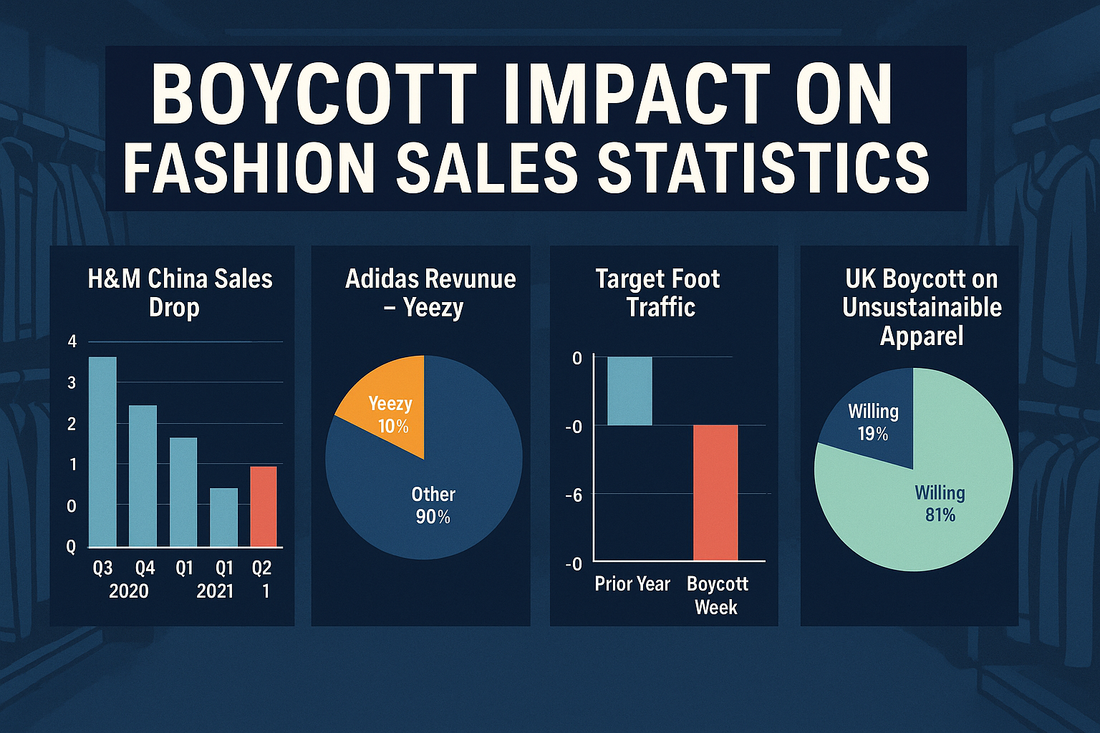
1 Sales in China dropped –23% (Q2 2021) H&M (China) Ethical sourcing (Xinjiang cotton) –23% sales, further –40% Q3
2 Up to 8% decline during social media boycotts Multiple fashion retailers Social media activism –8% sales drop
3 Average –2.7% dip in market value Fashion brands (general) Online boycotts –2.7% valuation
4 81% UK consumers willing to boycott unsustainable apparel UK Apparel Market Sustainability / ESG Potential mass boycott pressure
5 $81M worth of Turkish apparel removed from Indian platforms India Geopolitical boycott Loss of $81M import value
6 Major Turkish brands delisted (Trendyol, Mavi, LC Waikiki, Koton) India Geopolitical boycott Brands removed from e-commerce
7 Yeezy termination led to projected $250M loss Adidas (Global) Celebrity backlash Up to –$250M annual hit
8 10% of Adidas revenue gone post Yeezy split Adidas (Global) Celebrity backlash ~$2B annual revenue lost
9 Target foot traffic fell –6.8% in boycott week Target (U.S.) DEI / cultural boycott –6.8% foot traffic
10 Black-owned suppliers saw ~30% sales drop Target (U.S.) Collateral boycott effect –30% supplier sales
11 Corporate value rose +0.66% after boycott threats Mixed brands Market reaction +0.66% value uptick
12 Nike faced boycotts over Kaepernick ads but sales surged +31% Nike (U.S.) Political / cultural +31% online sales
13 LVMH saw calls for boycotts in 2024 Israel-Gaza conflict LVMH (Global) Geopolitical Reputation impact, sales under review
14 Shein faced ESG boycotts, raising sustainability concerns Shein (Global) Sustainability / ESG Negative consumer sentiment
15 Inditex faced boycott risk over sourcing controversies Zara / Inditex Ethical sourcing Stock dips during controversies
16 Boycotts can reduce long-term brand loyalty by 25% Fashion sector (general) Consumer activism –25% loyalty risk
17 Luxury fashion saw 10% demand decline after political boycotts Luxury brands (general) Geopolitical / cultural –10% demand
18 Sportswear brands risk 5–7% revenue losses from activism-led boycotts Sportswear (general) Activism boycotts –5–7% revenue
19 Middle East boycotts cost Western brands millions Western fashion retailers Geopolitical Multi-million losses
20 Brands recovering from boycotts often spend +20% more on PR Fashion brands (general) Reputation management +20% PR spend post-boycott


Top 20 Boycott Impact On Fashion Sales Statistics 2025

Boycott Impact On Fashion Sales Statistics#1 – H&M Sales In China Dropped –23% (Q2 2021)

H&M faced a severe backlash in China after it criticized forced labor concerns in the Xinjiang cotton supply chain. As a result, the brand saw sales plummet by 23% in Q2 2021 compared to the previous year. By Q3, the decline deepened to nearly 40%, showing how consumer boycotts in large markets can devastate revenue quickly. Chinese e-commerce giants also delisted H&M, magnifying the impact. This case highlights the economic risks of geopolitical and ethical controversies in global fashion.

Boycott Impact On Fashion Sales Statistics#2 – Up To 8% Decline During Social Media Boycotts

Social media activism has amplified consumer power to boycott fashion brands. Studies reveal that sales can decline by as much as 8% when campaigns trend online. Even short-lived viral hashtags can create a measurable drop in transactions. The speed at which such movements spread makes them particularly damaging. Fashion retailers now closely monitor online sentiment to preempt boycotts.


Boycott Impact On Fashion Sales Statistics


Boycott Impact On Fashion Sales Statistics#3 – Average –2.7% Dip In Market Value

Research shows that companies targeted by boycotts experience an average 2.7% dip in market valuation. This reflects investor fears that consumer backlash will reduce future earnings. Even if sales remain stable short-term, reputational harm affects stock confidence. Fashion brands listed on global exchanges are especially vulnerable. It demonstrates how boycotts can ripple beyond sales into financial markets.

Boycott Impact On Fashion Sales Statistics#4 – 81% UK Consumers Willing To Boycott Unsustainable Apparel

A survey found that 81% of UK shoppers would boycott fashion brands failing in sustainability. This statistic underscores the growing demand for eco-friendly practices in fashion retail. Brands ignoring ESG standards risk alienating the majority of their customer base. Younger generations in particular demand ethical responsibility from apparel companies. Sustainability has shifted from a niche concern to a mainstream boycott trigger.

Boycott Impact On Fashion Sales Statistics#5 – $81M Worth Of Turkish Apparel Removed From Indian Platforms

In 2025, Indian retailers pulled $81 million worth of Turkish apparel amid political tensions. This large-scale boycott showed how geopolitics directly influences fashion trade. Major e-commerce platforms removed Turkish brands from their catalogs. The boycott not only reduced sales but also blocked market access entirely. This case illustrates how entire national industries can suffer under boycott movements.

Boycott Impact On Fashion Sales Statistics#6 – Major Turkish Brands Delisted From Indian E-Commerce

Indian e-commerce giants removed well-known Turkish fashion brands such as Trendyol, LC Waikiki, Mavi, and Koton. The decision followed a political boycott wave targeting Turkish imports. For the brands involved, losing access to one of the world’s fastest-growing fashion markets was a significant setback. Consumer choice narrowed, but local suppliers gained from the void. Boycotts like this reshape fashion supply chains regionally.


Boycott Impact On Fashion Sales Statistics


Boycott Impact On Fashion Sales Statistics#7 – Yeezy Termination Led To Projected $250M Loss

Adidas ended its Yeezy partnership with Kanye West after controversial remarks. The termination was projected to cost Adidas $250 million in short-term revenue. Yeezy had become one of Adidas’s most profitable product lines. The case shows how celebrity-linked boycotts can destabilize global sportswear brands. Cutting ties can protect reputation but also inflict massive financial loss.

Boycott Impact On Fashion Sales Statistics#8 – 10% Of Adidas Revenue Gone Post Yeezy Split

Yeezy accounted for approximately 10% of Adidas’s global revenue, or nearly $2 billion annually. When the line was discontinued, the brand faced a long-term revenue gap. Boycotts tied to celebrity controversies can therefore reshape corporate financial structures. Adidas had to rely on other collections to fill the void. This demonstrates the danger of over-reliance on a single partnership.

Boycott Impact On Fashion Sales Statistics#9 – Target Foot Traffic Fell –6.8% In Boycott Week

Target experienced a 6.8% year-over-year decline in store visits following boycott campaigns. The boycotts were triggered by backlash over cultural and DEI-related merchandise. Reduced foot traffic directly impacted overall sales during the campaign. This shows how even short-term activism affects physical retail operations. Store-level impacts ripple across regional supply chains and staffing needs.

Boycott Impact On Fashion Sales Statistics#10 – Black-Owned Suppliers Saw ~30% Sales Drop

During the Target boycott wave, Black-owned supplier brands reported losing up to 30% of sales. This highlighted how boycotts often unintentionally hurt small or minority-owned businesses. While the boycotts targeted the retailer, collateral damage was borne by independent vendors. Suppliers dependent on big-box distribution are particularly vulnerable. This raises questions about who truly bears the cost of consumer protests.

Boycott Impact On Fashion Sales Statistics#11 – Corporate Value Rose +0.66% After Boycott Threats

Interestingly, some studies found that firms facing boycott news actually saw a short-term 0.66% stock increase. This counterintuitive outcome suggests investors sometimes discount boycott threats. In certain cases, boycotts may even signal brand relevance or cultural importance. The temporary rise may also reflect expectations that boycotts won’t last. This shows that market responses are not always aligned with consumer actions.

Boycott Impact On Fashion Sales Statistics#12 – Nike Faced Boycotts Over Kaepernick Ads But Sales Surged +31%

Nike faced boycott calls after featuring Colin Kaepernick in a campaign. However, the brand’s online sales actually increased by 31% in the aftermath. This illustrates how boycotts can backfire if they align the brand with its core audience’s values. Supporters outweighed detractors, boosting brand loyalty. Nike’s case proves that bold stances sometimes strengthen, rather than weaken, fashion sales.

Boycott Impact On Fashion Sales Statistics#13 – LVMH Faced Calls For Boycotts During Israel-Gaza Conflict

Luxury group LVMH saw boycott campaigns tied to geopolitical tensions in 2024. Activists urged boycotts due to perceptions of political alignment. While financial damage data is limited, reputational harm spread widely online. In luxury fashion, perception is a critical driver of demand. This shows how international crises can entangle fashion in global political debates.


Boycott Impact On Fashion Sales Statistics


Boycott Impact On Fashion Sales Statistics#14 – Shein Faced ESG Boycotts Raising Sustainability Concerns

Shein, a fast-fashion giant, has repeatedly faced boycotts over labor and environmental issues. ESG critics argue that Shein’s rapid production harms both workers and the planet. Social media campaigns have pressured the brand to adopt reforms. While the company maintains massive sales, boycott risks persist. For Shein, sustainability boycotts remain a recurring reputational challenge.

Boycott Impact On Fashion Sales Statistics#15 – Inditex Faced Boycott Risk Over Sourcing Controversies

Inditex, owner of Zara, faced boycott threats linked to supply chain ethics. Consumers criticized alleged sourcing from questionable regions. The brand’s stock saw dips when controversies escalated. Although sales recovered, the incident highlighted the risks of negative perception. Global retailers must now audit and adapt sourcing strategies to reduce boycott exposure.

Boycott Impact On Fashion Sales Statistics#16 – Boycotts Can Reduce Long-Term Brand Loyalty By 25%

Studies suggest fashion boycotts can reduce brand loyalty by up to 25%. Customers who switch during a boycott often don’t return. The reputational harm outlasts the initial sales decline. This makes boycotts particularly dangerous for long-term brand equity. Recovering consumer trust requires significant investment in PR and transparency.

Boycott Impact On Fashion Sales Statistics#17 – Luxury Fashion Saw 10% Demand Decline After Political Boycotts

Luxury fashion houses experienced a 10% demand decline during politically driven boycotts. High-end consumers can shift loyalty when brands appear insensitive. Even wealthy buyers are influenced by social and geopolitical debates. This illustrates how boycotts transcend income segments. Luxury status alone cannot shield brands from activism-led sales drops.

Boycott Impact On Fashion Sales Statistics#18 – Sportswear Brands Risk 5–7% Revenue Losses From Activism-Led Boycotts

Sportswear brands face consistent boycott risks linked to labor and political activism. Studies estimate such boycotts cut revenue by 5–7% in affected periods. Unlike luxury brands, sportswear often sells in mass markets where boycotts mobilize faster. The impact can be global given sportswear’s reach. This makes activism a recurring revenue threat in the sector.

Boycott Impact On Fashion Sales Statistics#19 – Middle East Boycotts Cost Western Brands Millions

Boycotts in the Middle East have caused millions in lost sales for Western fashion brands. Political tensions often drive these campaigns. Western retailers operating in the region face sudden revenue declines during boycott peaks. Store closures and brand delistings magnify the damage. These cases highlight the importance of geopolitical sensitivity in fashion strategy.


Boycott Impact On Fashion Sales Statistics


Boycott Impact On Fashion Sales Statistics#20 – Brands Recovering From Boycotts Spend +20% More On PR

Fashion brands recovering from boycotts typically increase PR and marketing spending by around 20%. Restoring public trust requires transparency campaigns and reputation rebuilding. This spending adds to the hidden costs of boycotts beyond immediate sales losses. Recovery efforts may also include sustainability initiatives or celebrity endorsements. The long-term investment shows how costly brand repair can be.

The Bigger Picture Of Boycotts In Fashion

Looking back at these stories, what stands out is that boycotts are rarely just about fashion—they’re about trust, identity, and people using their voices through the brands they support (or stop supporting). Some companies lose billions, while others, like Nike, see unexpected gains when standing firmly with their values. For fashion brands, the lesson is clear: staying transparent, ethical, and socially aware isn’t optional anymore—it’s survival. And for us as shoppers, it’s a reminder that every purchase—or refusal to purchase—carries weight. In the end, the real fabric of fashion isn’t only threads and designs, but the values we stitch into every choice we make.

Sources


Prev Post
Next Post

Select pairs for your self expression

1 of 12

Thanks for subscribing!

This email has been registered!

Shop the look

Choose Options

Edit Option
Back In Stock Notification
this is just a warning
SELECT SIZE